

 MATCH REPORT
 Follow Us
First session – the might of the English bowlers
When stand-in skipper Steve Smith won the toss and opted to bat first, there was a definite sense of nerves for the Australian openers. With the new pink-ball, a fresh James Anderson and Stuart Broad, the challenge was already daunting for the two openers, especially Marcus Harris, who has had a torrid time with the bat.
Scoring wasn’t tough, it was nearly impossible, long overs of frustration for the two openers, who couldn’t find any gaps at the sun-lit Adelaide Oval. Combine that with the challenge of facing two bowlers with 1000+ Test wickets, it put the hosts under immediate pressure. While Anderson tested the openers with slightly shorter length, Broad hit the fuller length, making it extremely tough for the two batters, even though the ball was not hitting the stumps. It made the two Australian openers play at it, a theme that set the tone for the entire day's play.
Broad’s variation against Marcus Harris, the shorter delivery put England on top of the proceedings, at 4-1, after the two openers played 45 deliveries without getting too many opportunities to pounce upon. Anderson against Labuschagne, aimed at the outside off-stump channel, which made it extremely tough for the right-hander to get going, to break the shackles as the runs dried up.
The continued barrage of bumpers from England
Once the sun started kicking in, making it tough in the heat for the English bowlers, they resorted a plan that New Zealand know very well – short deliveries. Ben Stokes in his first spell of the day ensured that he donned the Neil Wagner role, with the field set up perfectly for Marnus Labuschagne, who in the past has shown weakness against the short deliveries.
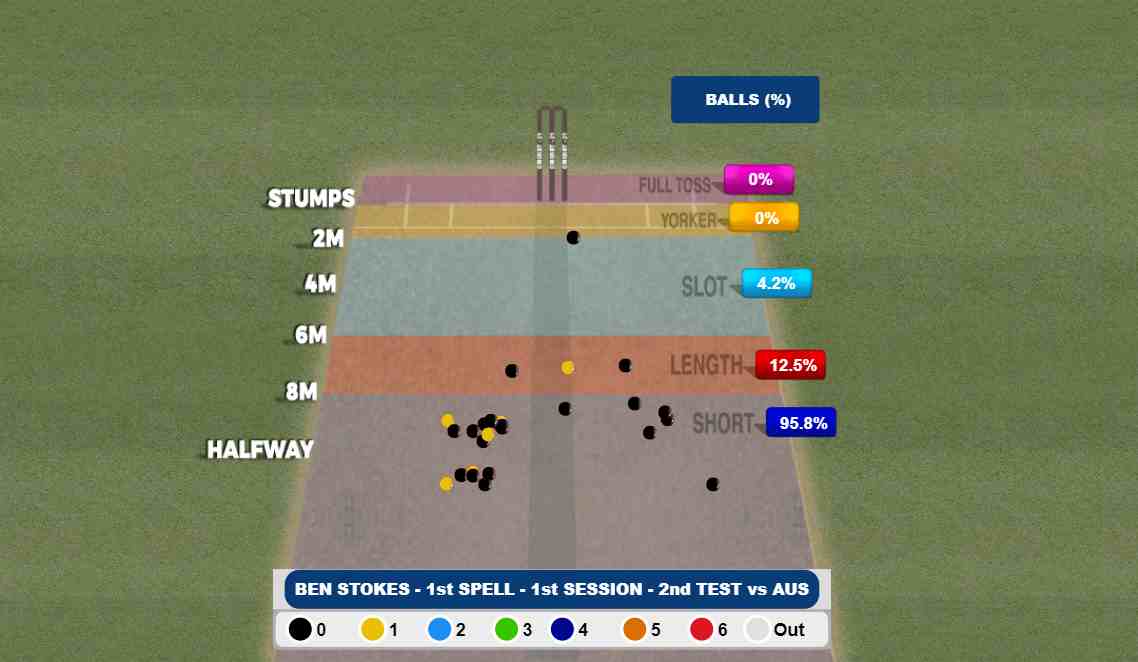
Against the shorter delivery, the right-hander has been dismissed once, dropped twice, in the series against India and New Zealand. His strike-rate, however, at 55.3, the highest among all batters, with minimum of 150 deliveries, serves as a double-edged sword. While he is evidently strong, his eagerness to proactively get runs off the shorter deliveries was in action against Stokes.
The all-rounder bowled a whooping 95.8% of the deliveries in the short length area, making it extremely tough for the right-hander. In general, during the day, Labuschagne faced over 70 short deliveries, where he only had a strike-rate of 22.7, making it extremely a tough day for the right-hander.
Second session – David Warner takes off for Australia
While the first session was a thunderbolt for Australian batters, the second session was far better for the batters. Both Warner and Labuschagne found more room as England were all over the place with the ball after the dinner break. The aggressive field setup didn’t help the bowlers any bit, as anything wide, fuller or both raced towards the boundary rope.
In the second session, the Three Lions bowling unit stuck by their plans, to challenge the batters in the length and shorter area, which accounted to 95% of their deliveries. But the fault wasn’t in the length but the line instead, with the ball coming on nicely for the two batters, who picked up 84 runs in 28 overs, at 3 RPO, after a session where they only scored at 1.8.
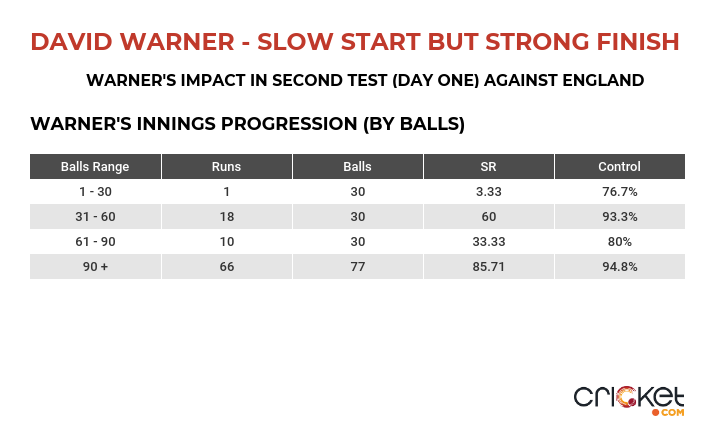
Warner, in particular, took the aggressive route post dinner, with his strike-rate jumping from 27.8 to 71.4, scoring 45 runs in just 63 deliveries, where he was in control of 92.1% of the deliveries, attacking 39.7% of the balls. Warner had scored at a strike rate of 36.3 in his first 80 balls. In his next 81 balls, he has scored at 74.1.
Third session – Tired pace attack meets attacking Labuschagne
After Tea, the English bowlers walked out with much aggression but that was it. The Australian pair of Warner-Labuschagne were in total control, with the latter finally showing his attacking intent, even when the ball was moving. The two showed utmost craftsmanship against the pink-ball, soaked in a lot of pressure early on before putting the pressure back on the English bowlers, who looked drained.
In the third session alone, Warner scored 30 runs off 32 deliveries, Labuschagne 27 off 45 deliveries as they kept the run-rate ticking, after what was a tough day for batting in Adelaide. The partnership between Warner and Labuschagne, embodies Test cricket in its essence, soaking up all the pressure before taking the attack to the bowlers.
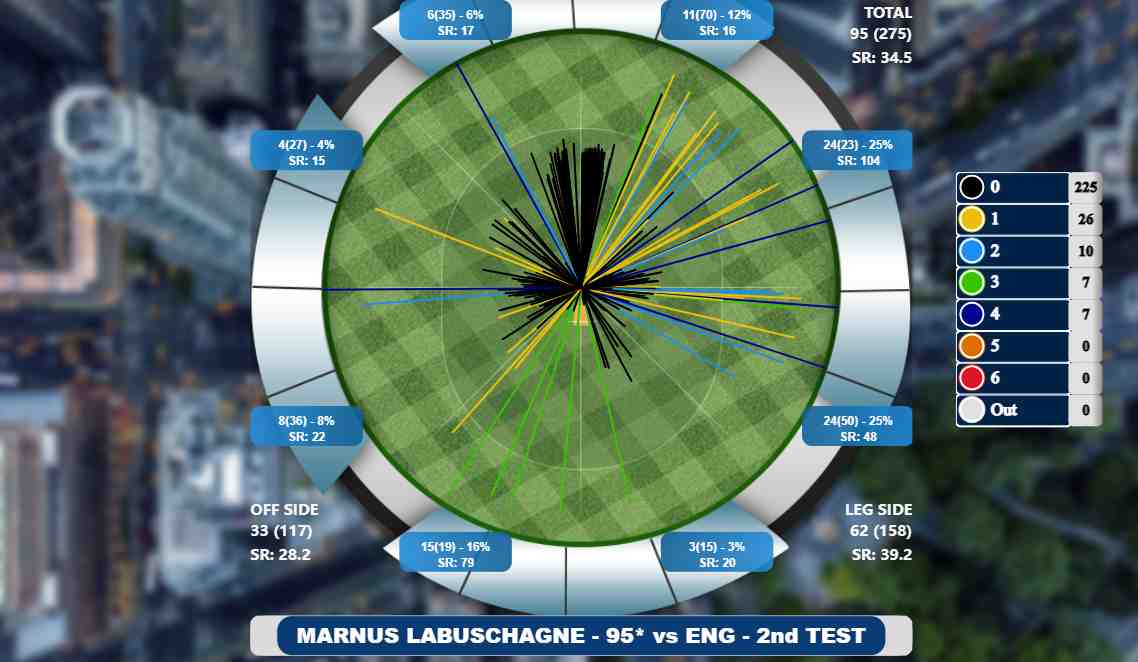
However, against the run of play, the left-hander hit the ball straight into the hands of Stuart Broad in short extra cover, departing after a 167-ball 95. While in the first session, the right-hander only got a strike-rate of 21 against the short balls but turn to the third session, Labuschagne tonked the ball at 95.
Unlike the first two sessions, the 27-year-old was in control over 89.1% of the deliveries, a jump from 86.8 and 87 that he had early on in the day. Even after the dismissal of Warner, the right-hander continued his aggression, with 69 runs for Australia in the one hour after tea, in just 17 overs, at 4 RPO, wrestling the control totally in the hosts’ favour.
The new ball and the extra bite under twilight
But as soon as the new ball was back in play, the England bowlers, especially James Anderson and Stuart Broad were back in business. However, the wicket column, one that is significant in nature evaded them. For Anderson, it was a drop from Jos Buttler, with the Australian No.3 batter on 95 and for Broad, it was the multiple balls that dropped short of the fielders.
Against the new ball, Labuschagne whose control never went below the 80% mark on the first day went drooping down to 61.1%. The English bowlers found the edge, got the Australian to drop his shoulder, getting the edge. But unfortunately, they were on the wrong side of luck, the side that ultimately could cost them the Test match, in conditions that are definitely not the best for batters.
Meanwhile, Australia took on the challenge, scoring just the ten runs in the last ten overs of the day, under lights, showing why Test cricket is still the ultimate test for the batters. It was only fitting that the day started with David Warner’s ‘no-run’ and ended with Labuschagne’s no-run.