

 OPINION
 Follow Us
England have had a torrid time thus far on the tour, both with the bat and the ball. The trend seemingly continued in Melbourne, on day one, when the batting, for the nth time in the series when they were crushed. But what is really interesting throughout this series is the battle between England’s bowling and their batting unit.
When Joe Root suggested that the bowlers were not ‘full’ enough, did not create enough opportunities with the pink ball in Adelaide, James Anderson did not take the comments lightly. In his column for the Telegraph, the veteran did not mince words, he slammed the conditions in Adelaide and asked more from the batters.
“We did not bat well enough on a pitch where the data said it was one of the flattest Adelaide surfaces ever produced and the pink ball did the least it has ever done in a day-night game,” Anderson said.
“Look at the numbers. They show both sides bowled similar lengths. They did not bowl any fuller than us. But it is a case of the difference in techniques of the batters. It must be, because they took 20 wickets and we didn’t,” he slammed back.
So, when England were shot for just 185, where the top-order once again collapsed, Anderson realized that the ball was in the bowler’s court. Late on day one, they couldn’t quite get the lengths right but on day two, the transformation was incredible.
The Anderson spell that wowed
Prior to the start of day’s play, Shweta Haranhalli had explored how England could make something out of the Melbourne Test and wrote a lot of words around Anderson. Walking into the Melbourne clash, England averaged 43.4 runs/wicket, had only 15 wickets at the venue and toiled the second most (103.7 balls/wicket).
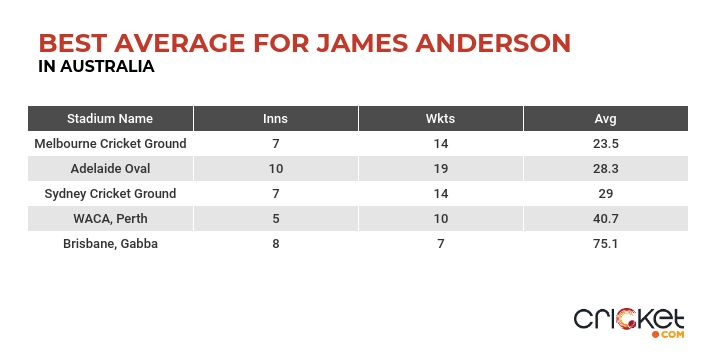
History suggested that the visiting Three Lions were in deep trouble but for the 39-year-old Anderson, it was his favourite venue in Australia. His numbers (14 wickets) in Melbourne paint a good picture but what was more important was his understanding of the game. At 39, the English bowler not just reinvents himself but elevates the entire bowling unit, purely on the back of game awareness.
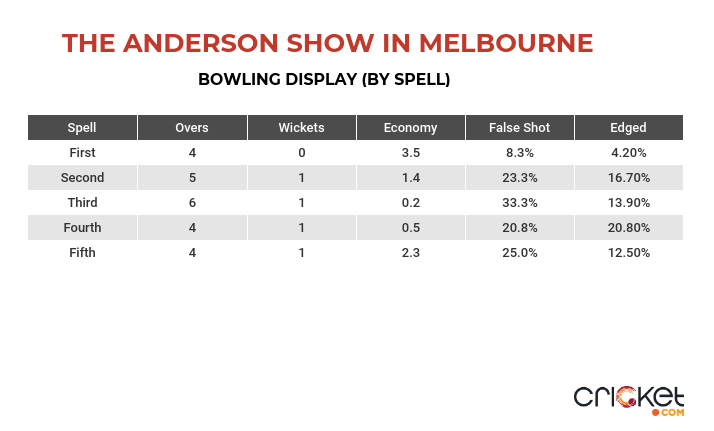
In his opening spell of the game, on day one, the veteran bowled a combined 83% on length and back of a length but the desired result didn’t come his way. Off his second spell, the one where he dismissed Warner, Anderson bowled only 76% in the probing length.
Anderson never ages, he only becomes better
On day two, his third and fourth spell arguably put England on top of the game. In the six-over spell that he bowled early on in the game, the 39-year-old just conceded the one run, picking up the prized scalp of Steve Smith. In more astonishing of number games, the one run that he conceded was also of a dropped attempt.
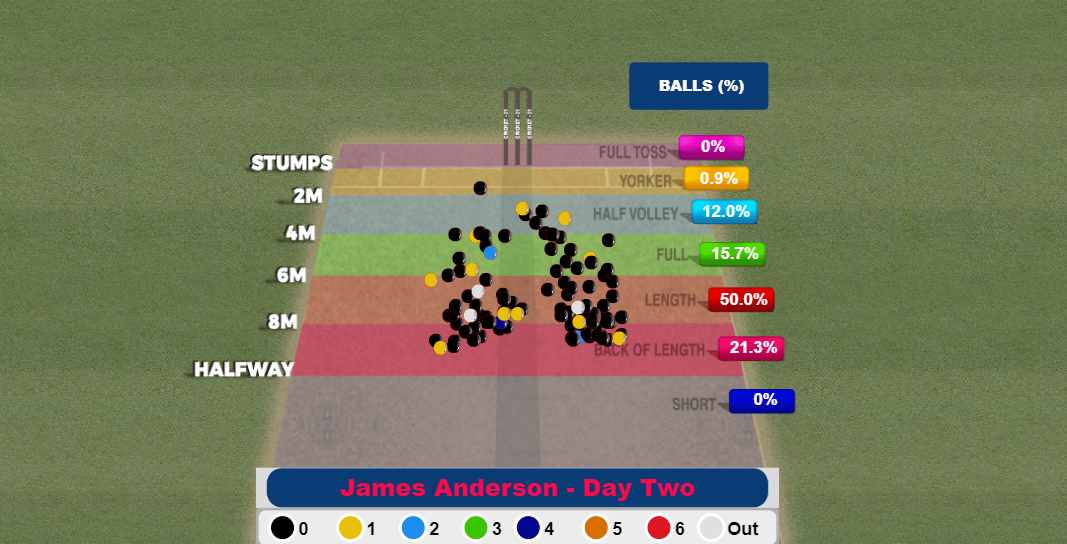
The most impressive aspects of Anderson’s bowling on day two were his control and the channel where he not only swung the ball away from the right-hander but also swung it back in, which was the major reason behind Smith’s downfall.
Even against the well-settled batter Marcus Harris, the veteran swung the ball just enough to take the outside edge, in what was one of the best spells at the venue. It wasn’t the end of Anderson, with the pacer picking up yet another wicket in his fifth spell, with four wickets across his five spells.
“Oh Jimmy, flies to his right, nearly 40 years in age, you can see in his body language, he is disappointed,” screamed the commentators after a searing attempt from Anderson in the field. The over is 82nd, England have spent a long time in the field, Anderson has completed five of his spells. And yet when the demand of a flying catch came his way, he nearly obliged. That's Anderson, at the age of 39.
Across his spells, despite bowling 23 overs, Anderson only conceded 33 runs and picked up four wickets, showcasing how he is like a fine wine, ages in perfection.
Marcus Harris finally shows mettle and desire
If Anderson’s bowling was the highlight for England, Marcus Harris returning to form was a joy beyond levels for Australia. Ahead of this Test, Australian head coach Justin Langer came out in support of the Victorian man, stating that the opener is an important and vital cog of the Australian setup.
“My experience, when Steve Waugh, Ricky Ponting, Mark Taylor or Allan Border said ‘you’re in the team’, you feel like Superman,” said Langer in support of Harris.
“You feel like you’re important to the team and Marcus Harris is important to the team,” he added.
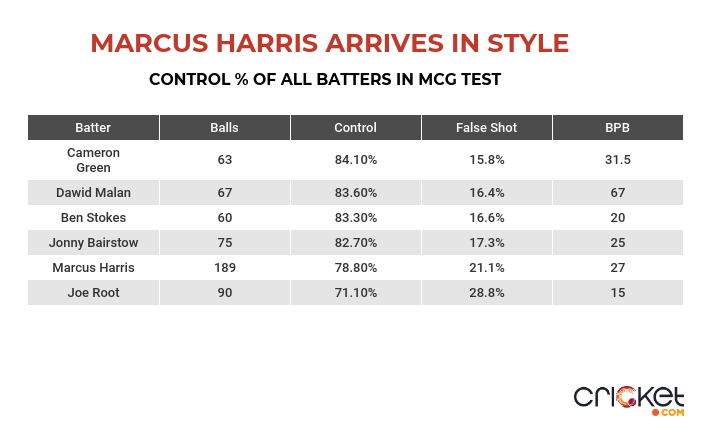
189 balls, 76 runs, Harris’ batting was ultimately one of the biggest reasons Australia came away with a huge lead at the end of their first innings in conditions that were tough for batters. Across the innings, the left-handed opener scored seven boundaries. But scoring boundaries wasn’t his virtues.
His virtues, the one that mattered was his patience, mettle and grit. Not a lot of Australian openers have survived the wrath. It further gets eliminated to the slimmest of chances when an opener gets a second chance. Harris got two and perhaps, his last chance was here, at home. That’s where he stood out.
Harris only attacked 15.3% of the deliveries he faced but showed mettle in his defense (53.4%) and was only beaten 9%. In fact, he was the only batter who had faced 100 deliveries at the MCG, with control of 78.8%, only behind Cameron Green, Dawid Malan, Ben Stokes, and Jonny Bairstow, who all played at least 50 deliveries.
It was only fitting that Harris’ international career was resurrected by his spell in the County season and later with Victoria. But in the toughest of batting conditions, at home, the left-hander stood out, embodying how valuable faith and trust are.
Justin Langer would be elated, not for the team but for Harris, who had endured a rough patch in Test cricket.