

 PRE MATCH ANALYSIS
 Follow Us
In many ways, Team India being hammered in the 50-over games is an even bigger shock than their failure to win the Test series as, heading into the series, South Africa’s form in ODIs was barely passable. The Proteas entered the series on the back of a 2-1 loss away to Sri Lanka, while in 2021 they also drew against Ireland while slumping to defeat at home Pakistan.
They had momentum on the back of the Test series win, yes, but it was always going to be difficult for them to pose a threat against a batting unit like India without the presence of both Nortje and Rabada. This is why the visitors started the series as overwhelming favorites even in the absence of Rohit Sharma.
For India to surrender the way they have, then, is alarming.
READ: A lifeless showing typified by Bhuvneshwar Kumar’s horror outing
While understandably mental fatigue has taken a toll on the players, the team’s performances across the first two games have been unjustifiable. Uninspiring on-field leadership has contributed to the side’s woes, but so have dubious off-field selection calls which have ended up putting the team in a tight corner.
There is nothing but pride at stake come the third ODI, but despite the game being inconsequential, Sunday is a golden opportunity for the management to win the trust of the supporters. The caravan will move to Cape Town, and there it will be interesting to see if the visitors end up rectifying the mistakes they committed in Paarl.
Blooding younger players - if not now, then when?
Rahul Dravid’s first assignment as head coach was an insignificant T20I series against New Zealand immediately after the T20WC, and in that the 49-year-old came under slight fire for being a bit too conservative with team selection. IPL stars Avesh Khan and Ruturaj Gaikwad exited the series without getting a single game, and only after the series was won 2-0 did India experiment, with both tactics and team selection. Though India eventually won the series 3-0, those games felt like a missed opportunity.
Exactly two months on, staring at Dravid & Co. is yet another opportunity to blood youngsters. Games don’t get more inconsequential than the dead rubber of a series not part of the ODI Super League. There is even more incentive for India to make wholesale changes, given the team picked across the first two matches got battered by Temba Bavuma’s side.
One really has to ask the question - if the younger, inexperienced players are not integrated into the side in ‘this’ situation, then when?
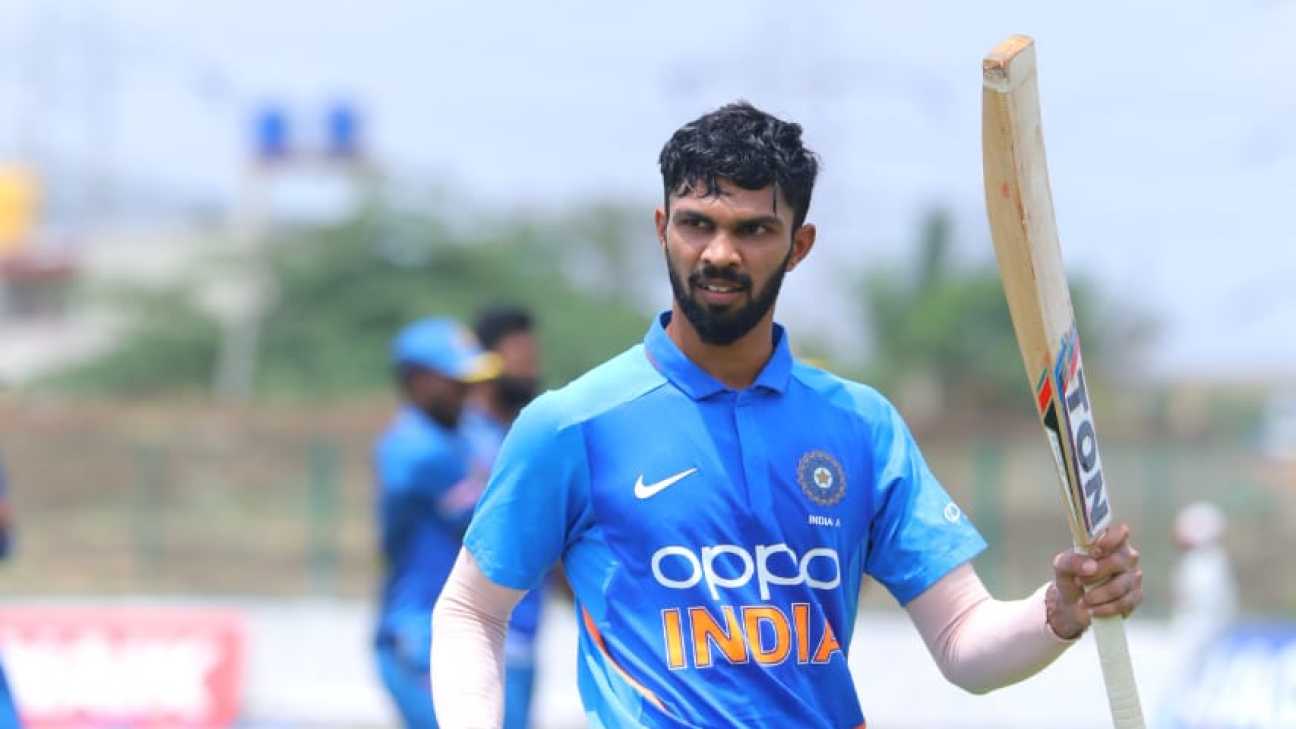
Ruturaj Gaikwad sat out the New Zealand T20Is despite winning the orange cap in the IPL, and the last thing he needs is to be sitting out the entirety of this ODI series too, given he is in red-hot form having top-scored in the 2021/22 Vijay Hazare Trophy season. Skipper Rahul’s move back to the top blocked Gaikwad’s entry into the side, and with the series done, it might be time for Rahul to slot down the order again, given he will anyway be demoted once Rohit is fit.
India should ideally also be looking at resting Bumrah, who has had a heavy workload starting from the Test series, while one suspects Bhuvneshwar Kumar’s place in the side might have become untenable after his showing in the second ODI. Both the aforementioned bowlers missing the third ODI will mean two of Mohammed Siraj, Deepak Chahar and Prasidh Krishna getting into the starting XI.
Making wholesale changes is no guarantee of the team getting a positive result, but, if nothing, it will be an indicator that the management looking at the bigger picture. The second ODI at Boland Park made it clear that India needed to shed conservatism, both in terms of selection and their on-field approach. Picking younger players and giving them the license to kill will be a step in the right direction.
Focus on the approach of KL Rahul the batter
As poor as KL Rahul’s captaincy in this series has been, the stand-in skipper hasn’t exactly covered himself in glory with how he’s gone about business with the bat in hand. In the second ODI, Rahul’s conservative approach was integral to India letting South Africa take control of the 10-20 overs phase after Dhawan got the team off to a reasonably quick start.
While Rahul played a key part in India getting to 287, stringing together a crucial 115-run stand with Rishabh Pant, the pace at which he operated was questionable. In 79 balls Rahul managed to score just 55 runs (despite getting multiple reprieves), and his innings was typified by lack of intent. It was far too slow by a modern-day anchor’s standards, and the innings, in a way, was exposed by Janneman Malan, who performed pretty much the same role far more efficiently (91 off 108).
In particular, highly problematic was Rahul’s approach against the part-time spin of Aiden Markram. The right-hander, in the second ODI, faced 19 balls of Markram - all inside the first 20 overs - and bafflingly batted at a strike rate of 68.4, striking a solitary boundary while playing 9 dots.
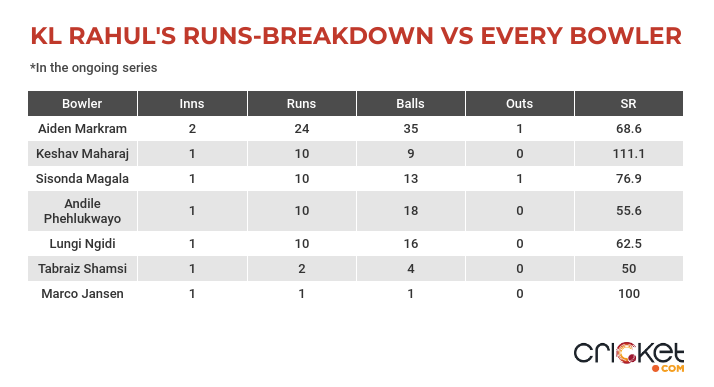
Rahul allowing Markram to ‘just bowl’ not only allowed South Africa to keep a check on the run rate, but pretty much handed them control of the game until Pant counter-attacked and wrestled back the initiative. Compare this to Malan, who, despite anchoring, managed to take 19 runs off the 21 balls he faced of Ashwin, who unlike Markram is a frontline bowler.
Regardless of where Rahul bats on Sunday, he will need to ensure that he does not get bogged down, even in a situation where he needs to anchor.
As the skipper of PBKS, Rahul, many a time, let captaincy influence and affect the way he bats. India can ill-afford to have the same shackled version of KL Rahul the batsman.
Probable XIs
India: Ruturaj Gaikwad, KL Rahul(c), Virat Kohli, Rishabh Pant (wk), Shreyas Iyer, Venkatesh Iyer, Ravichandran Ashwin, Shardul Thakur, Deepak Chahar, Mohammed Siraj, Yuzvendra Chahal
South Africa: Quinton de Kock (wk), Janneman Malan, Temba Bavuma (c), Aiden Markram, Rassie van der Dussen, David Miller, Andile Phehlukwayo, Keshav Maharaj, Lungi Ngidi, Sisanda Magala, Tabraiz Shamsi