

 OPINION
 Follow Us
In the wee hours on January 26, the board of selectors, headed by Chetan Sharma sprung a new surprise: the selection of Deepak Hooda in the ODI squad against West Indies.
Now, his selection isn’t a surprise because of the performance but because of vision that the selectors are staring at. Over the last few years, several stars, including Axar Patel, Krunal Pandya, Venkatesh Iyer and Hardik Pandya have all been exclusively picked as all-rounders.
Not to forget, the likes of Shardul Thakur, Deepak Chahar and Ravichandran Ashwin too have played the all-rounder role in the dearth of available players. The underlying issue not lies with the long list of players that were tried but their muddled role in the setup.
In the recent past, India have been guilty of a ‘horses for courses’ kind of selection, without looking at the long-term future. In Iyer’s case, the Madhya Pradesh all-rounder was given an opportunity on the basis of his two strong seasons in the Vijay Hazare Trophy but dropped out only after two ODIs.
And in return, this has affected the Men in Blue’s planning for the ODI format. The addition of Hooda and Washington Sundar only amplitudes the confusion and begs the question: Where lies the solution?
India’s quest for the elusive all-rounder
With Hardik’s crumbled cookie, are India seeking a complete all-rounder, to replace him or are filling the gaps in the setup according to the situation? Hooda’s selection only makes it extremely confusing.
Since 2017, barring one year, the right-hander has torn apart bowling attacks domestically, with a strike-rate of 96.3 and an average of 37.67, with over 1800 runs. 1273 of the runs have come at No.4, a position that he is most likely not going to play with India.
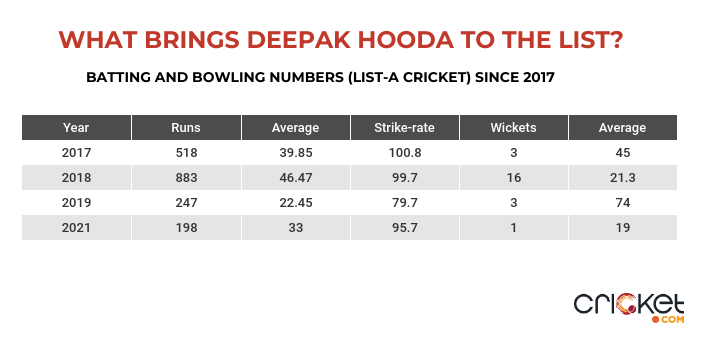
But with the ball, Hooda has sparingly done damage, his best days with the ball was in 2018, when he scalped 16 wickets. In the other three years since 2017 (17, 19 and 21), the all-rounder has just picked seven wickets and in addition, has only struck five times in the last five IPL seasons.
On the other hand, Sundar averages just 20.54 with the bat, at just 79.6 but his specialty comes with the ball. In the bowling department, the off-spinner has picked up 39 wickets, with 16 of them coming in the 2021 Vijay Hazare Trophy.
The other options and the confusion
India’s lack of trust in providing the likes of Krunal and Iyer an extended run has been equally puzzling. The two, prior to India call-up, had a great run domestically – both with the bat and the ball.
While Krunal made his impact with the bat against England, Iyer didn’t quite have the time to showcase his skills. The selectors not giving them an extended run is quite perplexing but what are the other options that India could consider, depending on the make-up of the playing XI.
India’s other choices of all-rounders in the country
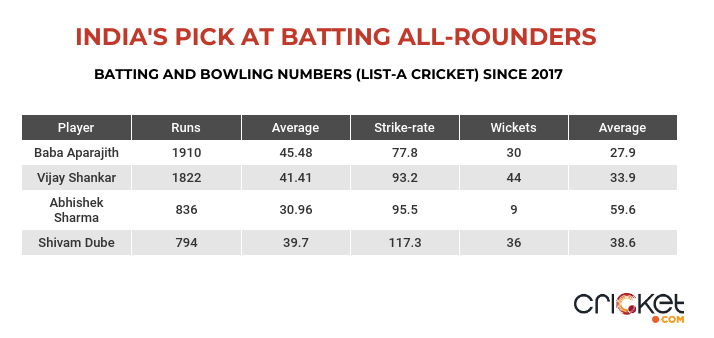
Two batting all-rounders that India could look at potentially in the long terms: Baba Aparajith and Abhishek Sharma. While the former has been a pillar of strength for Tamil Nadu in white-ball formats, the latter’s firepower could very well be handy. Since 2017, the Tamil Nadu all-rounder has scored 1910 runs, averaging 45.48, striking at 77.8, with 13 50s and 4 100s.
On the other hand, the Punjab all-rounder has scored 836 runs, averaging 30.96 but at a far superior strike-rate of 95.5, scoring a boundary every 6.7th delivery. With the ball, however, Aparajith’s 30 scalps puts him on top of both Hooda and Abhishek Sharma for that all-rounder position.
A surprise choice that India could field is the 28-year-old Shivam Dube. While he might have only scored 794 runs, his strike-rate (117.3) stands out at the domestic level. With the ball as well, Dube (36 wickets) aces past all competitions, only three wickets behind Washington.
Bowling all-rounders, who could make change
While the two obvious choices in the current make up of the Indian squad are Deepak Chahar and Shardul Thakur. Not only both possess the ability to pick wickets on a consistent basis in the 50-over format but also have shown their batting caliber.
In the presence of Ravindra Jadeja or Hardik Pandya (considering either of them are fit), India could very well utilize the two all-rounders. In six ODIs, Chahar has picked up eight wickets at an average of 34 and with the bat, has scored 141 runs, striking at 102.17 at an average of 70.50.
On the other hand, Thakur has picked up 23 wickets, at 40.21 and has scored 197 runs, at a strike-rate of 127.09. These two provide India with options going into the all-important ODI World Cup in 2023.
India’s wildcard options:
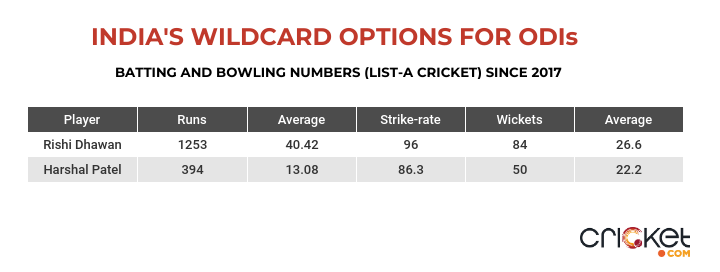
Even though the list is already extensive, India still have two extremely handy all-rounders to round up: Harshal Patel and Rishi Dhawan. The latter, who starred in Himachal Pradesh’s win over Tamil Nadu, picked up 84 wickets since the start of 2017, in just three seasons. With the bat, the 31-year-old has tonked 1253 runs, striking at 96, showing that he is still a prime option if India are looking at.
If not Dhawan, there is Harshal Patel, an option that India have already unleased in the T20Is. With Harshal, India not only get a bowler, who can pick wickets in the middle overs, which is one of India’s prime concerns but also be handy with the bat.
But whichever option that India go out, one thing remains integral to what makes them successful: a long run.