

 PRE MATCH ANALYSIS
 Follow Us
India should be playing England more often. Since 2018, the two sides have played only seven white-ball games – four ODIs and three T20Is. The only major side against whom India have played fewer games since is Sri Lanka (six). It is worth mentioning that India played their island neighbours in a copious 13 white-ball games in 2017.
It took a long time for England to embrace white-ball cricket. It is taking longer for teams to adjust to their dominance. England have been the recent trendsetters in the white-ball game. They are the current 50-over champions and also the favourites for the 2021 ICC Men’s T20 World Cup. This is a reason enough for India to play the England side more often.
The fact that India have a win percentage of 42.9% in white-ball games against England since 2018, lower than any other side, supplements the need for India to test themselves against the best. A total of eight white-ball games, five T20Is and three ODIs, in the next fortnight or so, is going to change that.
A problem of plenty
With an ever-widening bench, India have at least two options for every spot. Identifying the first-choice options for each role to gel with the holistic team strategy is going to be the primary task for the management from now till the World Cup. Nothing else will have a bigger impact on success or failure in the mega event.
India have four established players for the top-order. Of them, Rohit Sharma and KL Rahul have been their most successful opening pair. Being a left-hander, Shikhar Dhawan is a tempting option but his T20I strike-rate is a notch lower than the other two. Virat Kohli picks himself in an XI in every format. The issue with all four players is that they are anchors who look to build their innings. Caring less about one’s wicket and more about maximizing the runs comes lower down the order for India.
Number four has been a treasure hunt in India for years now. In ODIs, Shreyas Iyer seems to have sealed the spot at present. But, in T20Is he adds another anchor to the side. India might also be tempted to play all the four top-order players with Rahul batting at four. But, this will be shooting themselves in the foot due to the reasons mentioned above. Ahead of the game, Kohli announced that India will be sticking with Rahul and Rohit as their opening pair.
India need an enforcer at number four. Since 2018, India’s run-rate in overs 7-15 has been a notch lower than other sides eyeing the coveted trophy later this year.
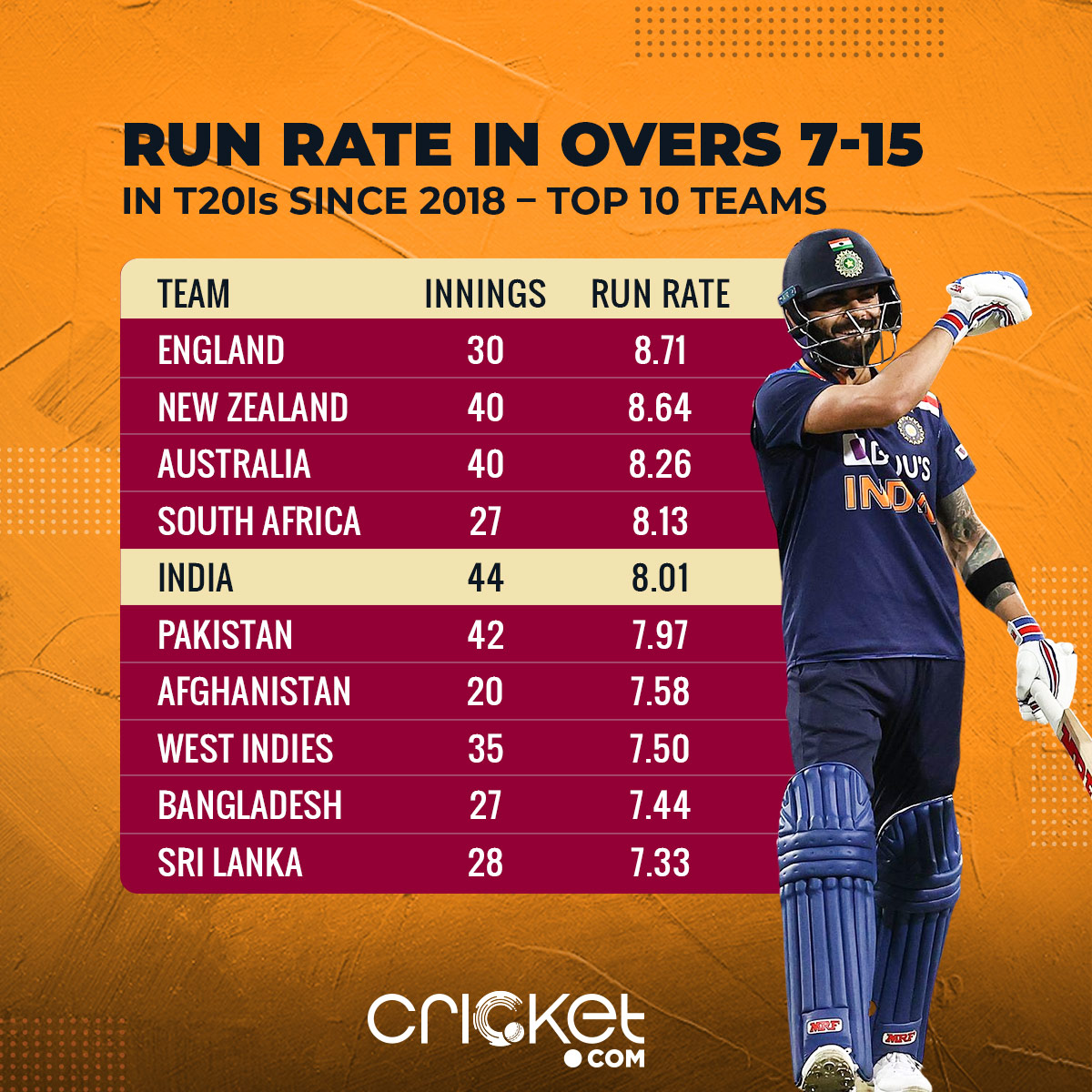
Hence, the time is ideal for India to experiment with players like Suryakumar Yadav and Ishan Kishan. Surya is a 360-degree player and at the peak of his prowess. Kishan adds a left-handed option in the top-four.
With what he has achieved in the last three months, Rishabh Pant is unavoidable. Not able to identify a suitable approach in the white-ball game yet, a renewed confidence from within and outside might make him ready for bigger things. India need him to succeed to be able to add a left-hander between a herd of right-handed batsmen.
Bowling or not, Hardik Pandya is a must-have player in the limited-overs format. His T20I strike-rate of 166 since 2018 is more than 20 points above the next-best, Rohit (144.5). Hardik is the only proven batsmen in the team with a radical approach needed in the modern T20 game.
Axar Patel has had a dream start to his Test career. But, his role in the side was of a bowler first. On tracks that helped him, he was a nuisance to the English batsmen. In the T20Is, the ball might not offer as much assistance and the team will need him with the bat too. Like they needed Ravi Jadeja in Australia. Unlike in Tests, his abilities with the bat will be equally important for his future in the team.
In the bowling department, Bhuvneshwar Kumar’s return is a welcome sign. Yuzvendra Chahal is one of the best white-ball spinners going around. T Natarajan is nursing a fitness issue of his own which opens the door for Deepak Chahar. There will be a three-way contest for the one spot at number eight. If Hardik is fit to chip in, India might opt for a spin option of Washington Sundar. If not, they are likely to go in with either Shardul Thakur or Navdeep Saini.
England side is not perfect
The ideology of the new-age England white-ball side is simple. Bat deep and without a lot of care about one’s wicket. England have been head and shoulder above all other teams on the batting front. But, this has resulted in a weaker bowling unit.
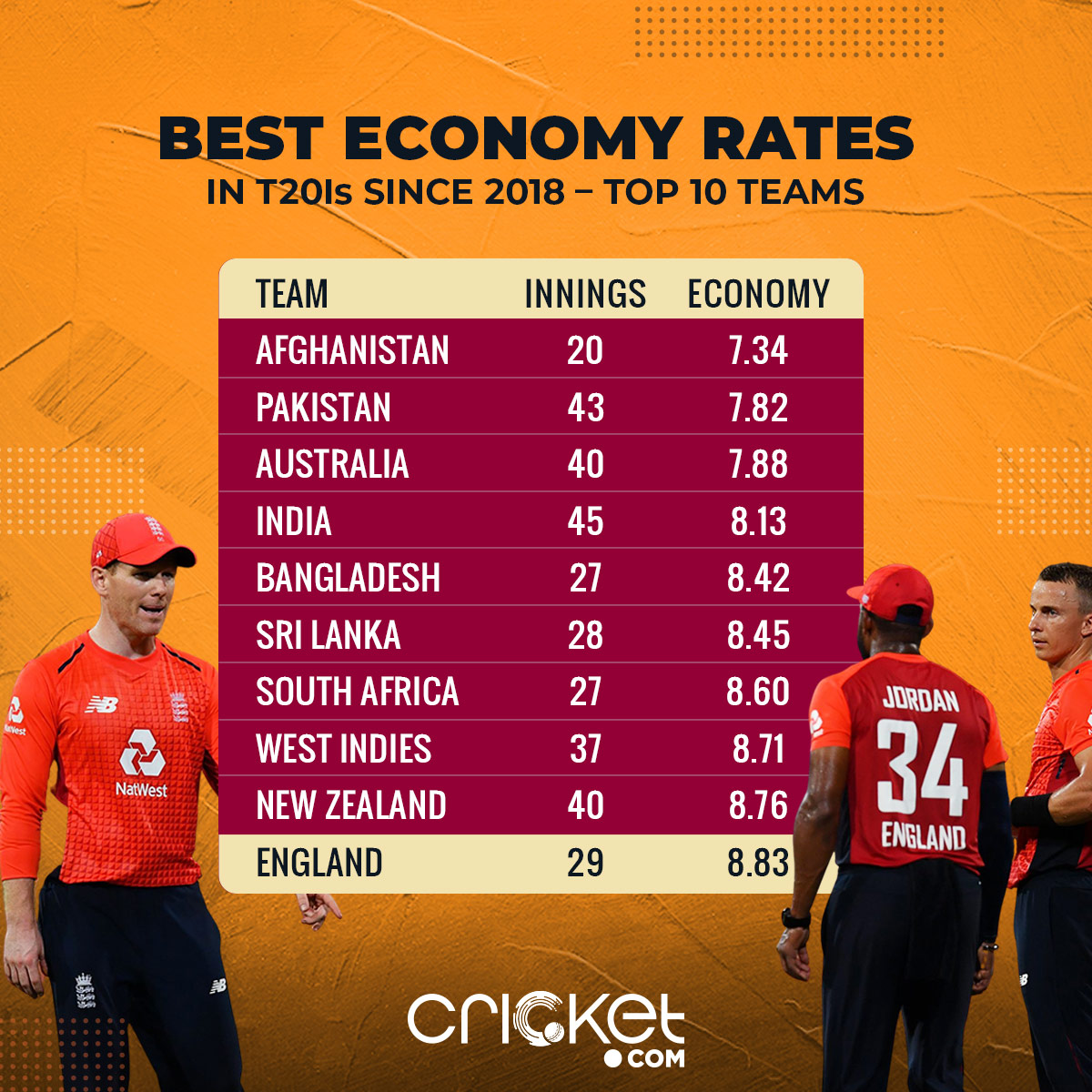
All frontline pacers except Jofra Archer have an economy of 8.7 or more since 2018. Nursing an elbow injury, Archer’s absence might amplify England’s concerns with the ball. With an economy of 7.3 in this period, Adil Rashid has been their most effective T20 bowler. But, he is yet to play India in India since improving his credentials.
Adapting to the conditions in Ahmedabad will pose another challenge for the English batsmen. The focus for India in the series will be to settle down on a batting line-up. But, the contest between India’s bowlers and the English batsmen will decide the fate of the series. For both sides, there cannot be a better test before what is to come later in the year.
Probable XIs
India: Rohit Sharma, KL Rahul, Virat Kohli ©, Suryakumar Yadav/Shreyas Iyer, Rishabh Pant (wk), Hardik Pandya, Axar Patel, Washington Sundar, Bhuvneshwar Kumar, Deepak Chahar, Yuzvendra Chahal
England: Jason Roy, Jonny Bairstow, Dawid Malan, Eoin Morgan ©, Ben Stokes, Jos Buttler (wk), Moeen Ali, Sam Curran, Adil Rashid, Tom Curran, Chris Jordan
The preview has been updated after Kohli’s inputs on the opening combination