

 MATCH REPORT
 Follow Us
It seemed like a repeat of the first T20I. In many aspects, India were a lot better than that night but overall, the game proceeded at the same pace. They lost the toss, were put in to bat, rattled by pace and were chasing the game for the most part of it. England displayed why they are the number one ranked team in the format, especially with their batting approach tonight, and cruised home to an eight-wicket victory, with 10 balls to spare.
The false start 2.0
Rohit Sharma’s return meant Ishan Kishan went down in the batting order. With no left-hander to tackle at the top, Adil Rashid took the new ball again and his first over hinted at the spin-friendly nature of the track. Each of the first two balls turned - first one a leg break and the second, a wrong’un. The third one stayed a touch low.
Despite the deck appearing slow, England’s new-ball pacers - Jofra Archer and Mark Wood - made the new ball talk. Archer boasts a great record against Rohit. It is surprising as Rohit is one of the few batsmen going around who is unperturbed by pace. But Archer showcased why he usually gets the better of Rohit. He bowled six deliveries at him and the right-hander was not comfortable on any of them. In fact, Rohit had a reprieve on the first ball against Archer when he chipped one back to the bowler. Given Archer’s nonchalant brilliance as a fielder off his own bowling, Rohit was lucky that the ball went through the bowler’s hand.
KL Rahul, on the other end, also struggled to put bat to ball. Wood, back in the side, was breathing fire and stretched Rahul’s run of wretched form by castling him for a four-ball duck in his first over. After 15 balls into the innings, India were one wicket down without a boundary.
The boundary count got underway in the next over in the most unpleasant manner. Rohit inside-edged Archer to the fine-leg boundary. Next over, Rohit began with a more assured boundary. However, when Rohit backed away with the intention to accelerate, Wood hit back at him, following him with a bouncer which the right-hander pulled to Archer at fine-leg.
Kishan, in at three was probably another experiment by India’s perplexed white-ball side. He top-edged Chris Jordan in the sixth over to Jos Buttler. They were 22 for three after the Powerplay in the first T20I. Tonight, they were 24 for three.
Virat Kohli and Rishabh Pant gave India hopes of a revival. Pant got off the mark with a boundary on the second ball of the seventh over. Kohli welcomed Rashid back to the attack by charging him down the wicket for a boundary over mid-off. The two added 40 runs for the fourth wicket in 35 balls. But calamity (read brain fade) struck the innings soon.
Having run two, Kohli called Pant for the third one on a back-of-the-hand overthrow from Jos Buttler. Overrunning the second run, Pant had no chance to complete the third. Kohli stopped midway to check Pant’s response to his call. Pant decided to go for the run and it turned to be a suicide attempt. Kohli did his part well by the end of the innings but Pant’s inopportune departure had an impact on India’s innings.
A Kohli classic
While everyone struggled in the Powerplay, Kohli kicked off with a glorious cover drive for four giving a hint of his golden touch which seemed to have evaded him for a while now. However, Kohli could not build on that shot. Starved of strike, Kohli faced only 23 balls during this nine-over phase. England pacers also didn’t provide him the full balls to churn out those occasional boundaries. Consequently, the India skipper managed only 24 runs off those 23 balls. His strike-rate at the end of the 15th over phase was a paltry 96.5. India scored only 63 runs in the middle-overs.
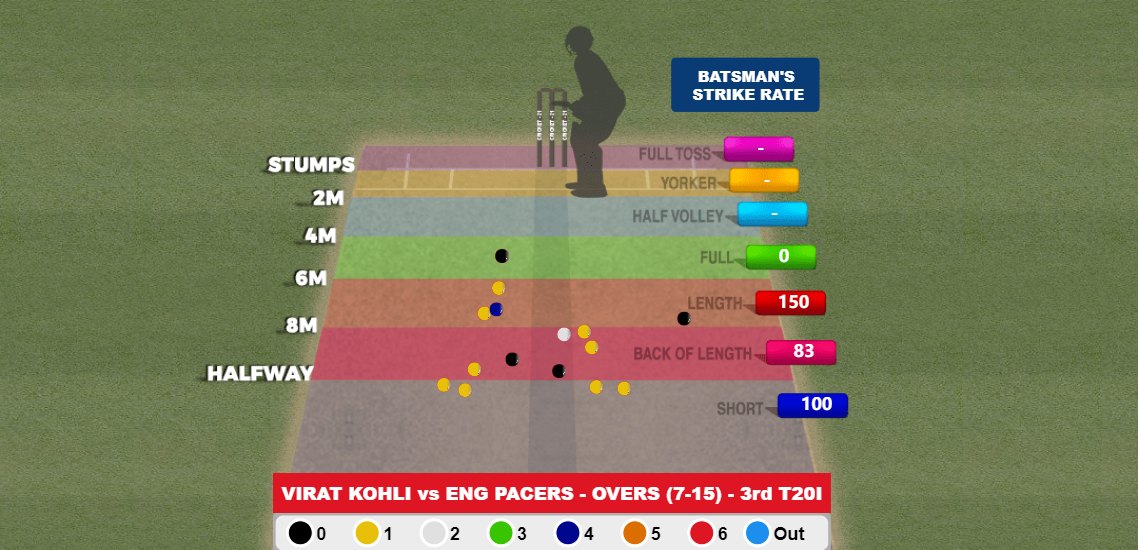
But great players find a way to tackle such hardships. T20 demands you to do it as quickly as possible and Kohli was up on his feet in the last phase of the innings. He made a conspicuous attempt to put those short balls away. The right-hander moved around the crease and exploited both sides of the square with brilliant pull shots and uppercuts. Kohli, thus, made the English pacers bowl full and exploited them to his advantage.
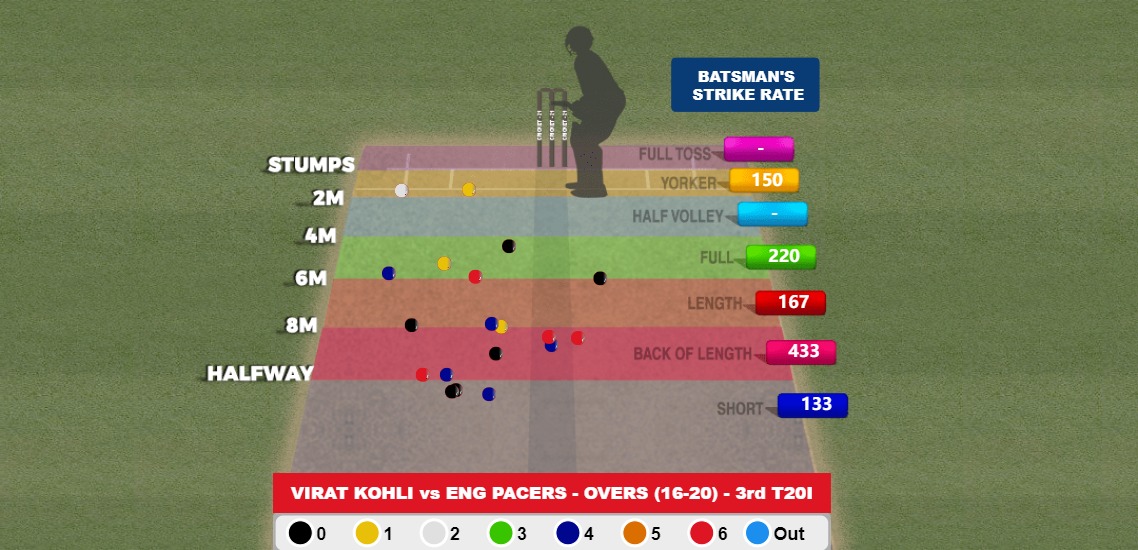
The 18th over was the best example. Kohli went wide of the crease to pull Wood over the midwicket fence for a maximum. Next ball, Wood pitched it up. This allowed Kohli to caress the ball over mid-off for another half a dozen. When Wood went short again, Kohli scythed the ball to the third man fence for four.
India scored 69 runs in the last five overs and 49 of them came from Kohli's bat. Even Hardik Pandya couldn’t get hang of the extra bounce and departed for a 15-ball 17. However, he was involved in a crucial partnership of 70 runs from 33 balls before being dismissed to another short ball on the last delivery of the innings. Kohli scored an unbeaten 77 from 46 balls.
Buttler’s fearless reply
Conceding only seven runs in the first two overs, India began their quest to defend 156 in a spirited manner. But those high spirits were flattened quickly by Buttler. Despite Jason Roy’s early departure, Buttler brought England within 100 runs of the target at the end of the Powerplay.
He unleashed his fearless approach by stepping out on the first ball against Chahal, depositing him over the long-on boundary. Being the wicketkeeper, he must have noticed the turn available for the spinners but didn’t fret about it. The leg-spinner snared Roy’s scalp a couple of balls later but Buttler, back on strike after two balls, again struck Chahal over long-on for a maximum.
He raced to 43 off 17 balls in England’s Powerplay of 57 for one. Once the field spread out, he calmed down but remained equally lethal with his constant strike-rotation. During the field restrictions, he hit three sixes and did not run any twos. In the middle-overs, he collected five twos and did not go big until Washington Sundar pitched one right in his slot.
Buttler’s presence also forced India to not use Sundar with the new ball. With only five bowlers in hand, this had a knock out effect on the home side.
Buttler reached his fifty in 26 balls, ending at 83 not out. He put up a 58-run stand with Dawid Malan where he was the senior contributor. For the third wicket, he added an unbeaten 77 runs with Jonny Bairstow, who remained unbeaten on 40 as England went 2-1 ahead in the series.