

 ANALYSIS
 Follow Us
Jimmy - Now and Forever
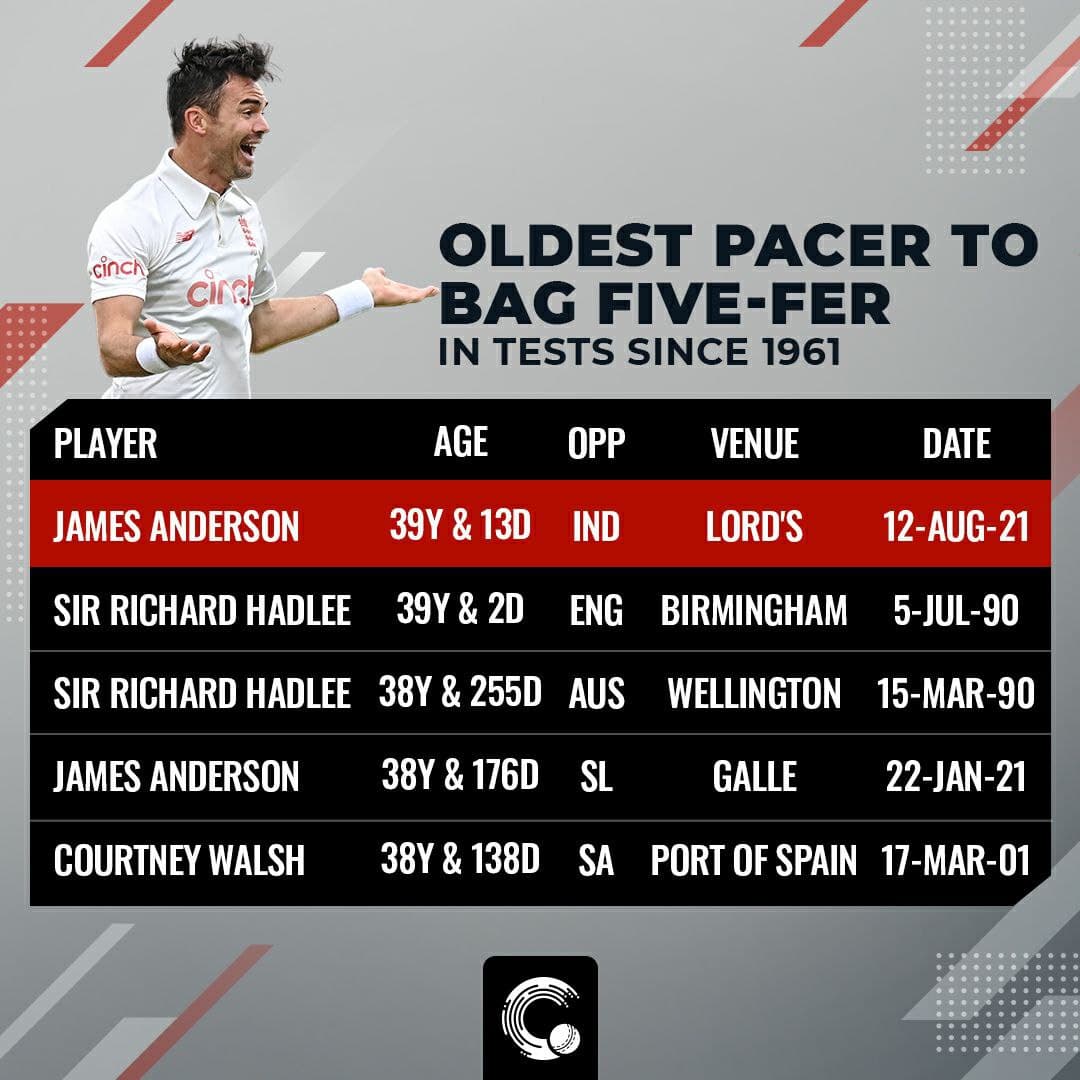
There is nothing new that one can write to make sense of the first wonder of the world - James Michael Anderson. Perhaps it is prudent we don’t eulogize the Lord’s fifer today, for it has been a recurring pattern and a saving grace for the English side for as long as you can remember. But for a bowler who has made a life out of pitching it up and thus inducing an edge with insane regularity, there is a change in pattern at the twilight of his career.
Since January 2020, Anderson has bowled 77.4 overs worth of full balls, averaging 50.4 in that length. But when he pulled the length back a bit, his average significantly improves. In the aforementioned period, he has averaged a cool 11.9 when bowling good length deliveries. He stuck to the pattern at Lord’s as well, landing 68.4% of his deliveries at good length and all five wickets in the first innings were in that zone alone.
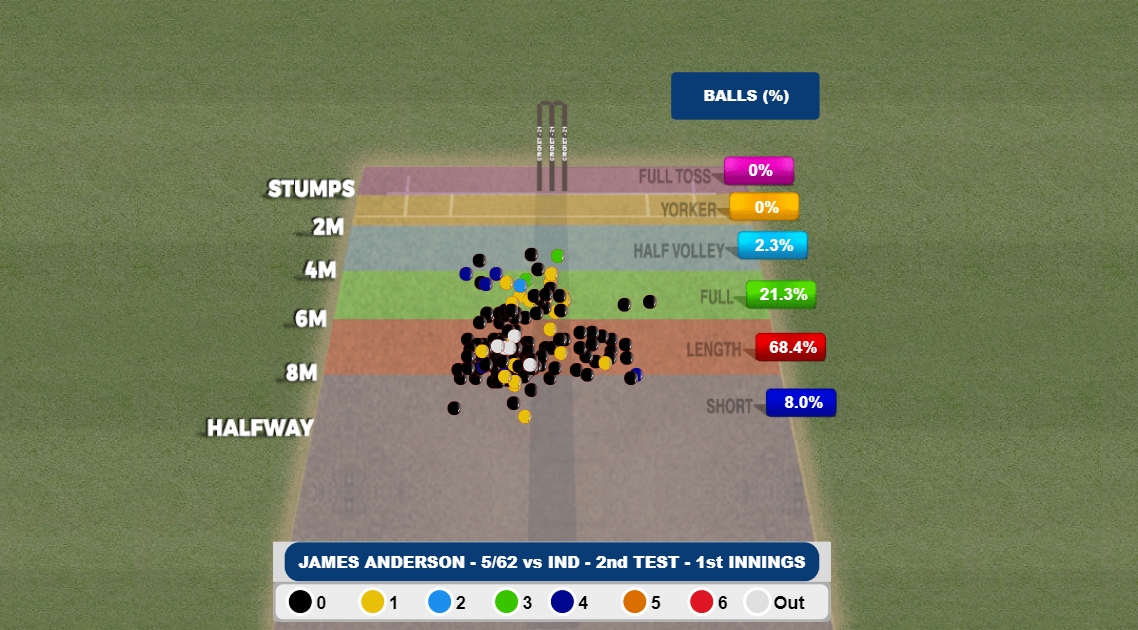
Jimmy is a magnificent bowler in his own right and the tirelessness with which he has approached his bowling alone will make him one of the most important, if not the most important, chapters of the future pace-bowling manual. However, the way he has stuck to that terrific length consistently has ensured that he has stayed relevant in a sea of changes in world cricket. That is an irrefutable position to be. For further understanding, I would leave you with a simple creative under this. Do refer to it and make your judgment on the Burnley man.
Siraj thrills and frustrates in equal measure
There is a special thing about Mohammed Siraj. There is never a dull moment when he bowls. Be it on the unresponsive pitches in India or the bouncy tracks of Australia or the grassy tops of England, he has always stuck to his own idea of pace-bowling, yielding massive results for the side as well. Not only that, he has proven himself as a workhorse by bowling an average of 20.5 overs per innings in Tests outside India while no other Indian pacer has averaged in the 20s since his debut.
No matter how good a pacer bowls, they earn their ultimate currency, wickets, by making the batsmen play. At Lord’s, England batsmen have left alone 14.8% of the balls against Siraj. Among pacers, only against Sam Curran the leave percentage was lesser (14.4%). By forcing them to play more, Siraj created more chances. It is no surprise that he accounted for both Dominic Sibley and Haseeb Hameed.
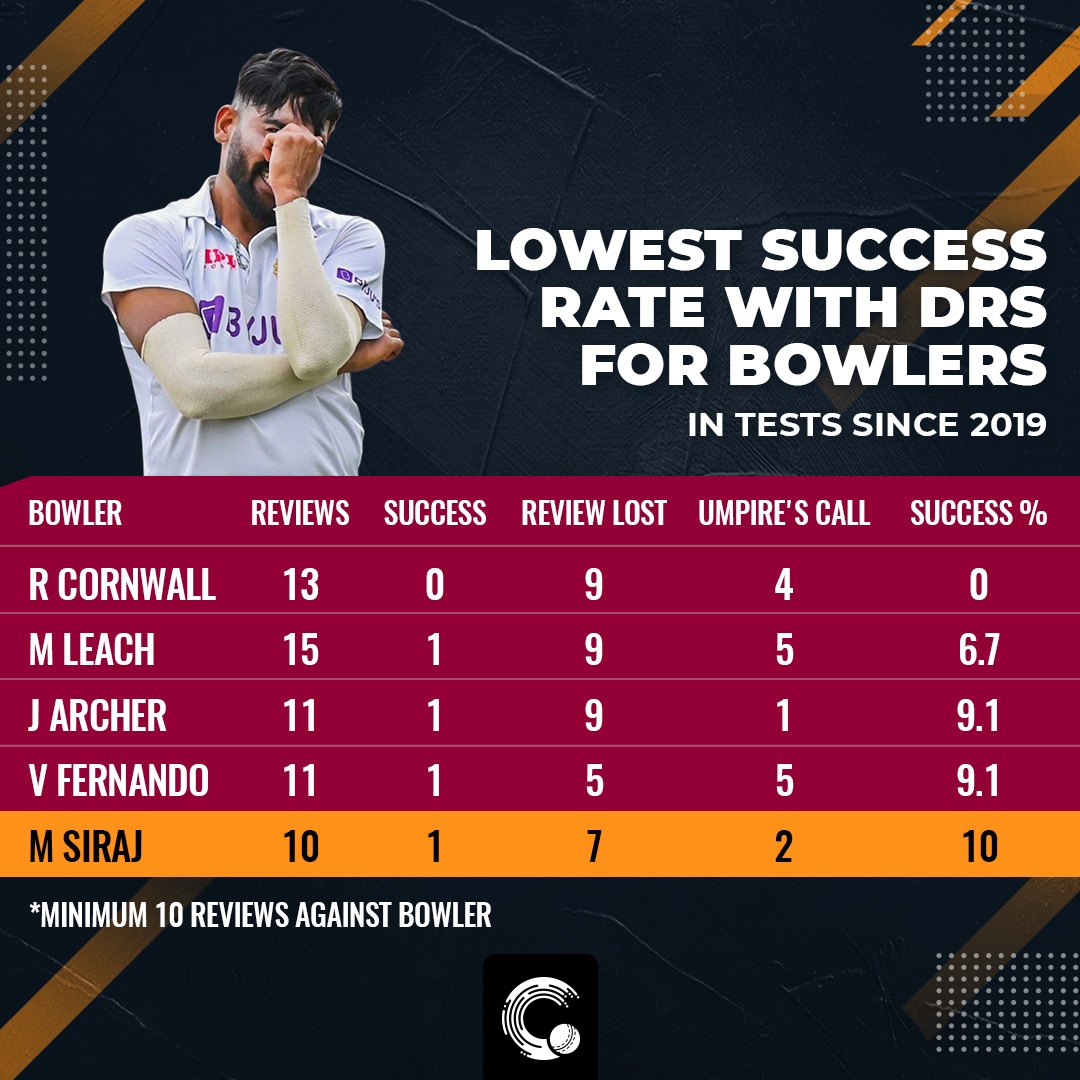
However, Siraj was also the reason India lost two reviews for no strong assertion. When his second review plea forced Kohli to go upstairs, only to return disappointed, it put him in a rather unwanted list of bowlers with the worst review success rate. Only four bowlers, with a minimum of 10 reviews, have had a worse success rate. In such a situation, one would expect Kohli to be more prudent and judicious but unfortunately, it hasn’t been the case this series.
Root’s Risk vs Reward equation
Joe Root is a classic anomaly of a Test match batter. Especially in England where the ball moves in and out with equal potency, Root’s batting has taken a nosedive. But since the beginning of the series, Root has employed a more attacking approach to reduce the pressure piling on him. In the series so far, Root has scored at a strike rate of 122.6 on full balls from the pacers (in the 2-6 meter region from the stumps), But he has also played these with the least amount of control 77.4%. What does it tell you?

That here is a batter with a range of strokes that is often undervalued for his stoicism. Root has been lucky enough to survive 355 balls in this series with a false shot percentage of 18.3% which is way higher than his career FS% of 14.7%. An average batsman would have been out six times already after these many false shots. Comparing his leave percentage further tells you a story of its own. Rahul who has only 18 runs less than the English skipper, has left alone 30.9% of deliveries as compared to Root’s 10.4%. It is this risky approach that has played a big role in the Yorkshireman turning the table around to bat more freely in England - his own country where he hasn’t really done well in recent times.