

 PRE MATCH ANALYSIS
 Follow Us
Two identical games sealed India’s fate in the ODI series and have set the tone for rest of the summer. Indian pacers have been guileless while Steve Smith has been imperious. If we go by the script for the first two ODIs, Indian fielders should be ready to spend long days in the field for most of the 50-odd days left on the tour.
Meanwhile, India will get a respite on two fronts in the third ODI. First, the venue will move from the Sydney Cricket Ground that has been a nightmare for the bowlers in recent years. At stadiums with a minimum of five ODIs since 2018, a batting run-rate in the first innings of 6.4 at the SCG is the third-highest overall after Trent Bridge (6.9) and Pallekele (6.7). Teams move to the Manuka Oval for the third ODI. While there has been no ODI played here since December 2016, it saw runs in excess of 350 then. So the relief for India will come only if the pitch is not a haven for run-scoring like the SCG.
The second and the most important is the twin change in personnel in the Australian squad. Having injured his groin while fielding during the second ODI, David Warner’s injury looked serious. As it turns out, he will now miss the rest of the white-ball leg i.e. the third ODI and the T20I series. Along with him, they have rested Pat Cummins for the same tenure to manage his workload.
Warner’s absence is sure to bring a sigh of relief in the Indian camp. And shouldn’t it after the carnage wreaked by the Australian top-order in the first two ODIs. It is an argument for another day if KL Rahul would have said what he did in the absence of an unprecedented camaraderie between the two sides. But, he made it clear that the Indians consider him a big threat for the entire tour and not just the white-ball leg.
With Cummins, his absence will provide India with an opening which they can plan to exploit. Out of all the departments where Australia have outplayed India, none is more telling than the difference in the quality of their third seamers.
The two advantages served on a platter for India will not be enough to stop Smith and others from causing further embarrassment to India if they do not alter their plans. There is serious recalibration needed in the bowling department and some tweaks in batting.
Breaking the monotonicity
In the second ODI again there was a problem of not bowling tight channels for a sustained period for India. There was a boundary ball or two sprayed across in most overs that kept India devoid of wickets. Apart from a maiden from Jasprit Bumrah to start, there was hardly an over that consisted of six good balls.
While the Australian bowlers tried slower balls bowled into the pitch, attempted wide yorkers and deployed cross-seam deliveries, their Indian counterparts were just feeding the ball to the batsmen. There was no Plan B from India’s seamers while they were getting no help from the surface.
As Virat Kohli and Aaron Finch revealed later, it was a four-over spell from Hardik Pandya that showed the way to bowl on that pitch. For Australia as well, the seamer with the least pace but an affinity to slower balls turned out to be the best on the night.
Lack of consistency and street smartness from the bowlers was compounded by some strange decision-making.
While Navdeep Saini was running in to bowl the 34th over, a stat popped up on the screen stating that no Indian pacer had bowled three overs in a row. This did not change even for the course of the innings barring a three-over spell from Bumrah at the death.
Whether this is the inherent impatience brought about by T20 cricket or a plan to not allow the batsmen to line up a bowler, this did not work for India. One of the bigger reasons for India’s loss in the first ODI was the opening partnership between Warner and Aaron Finch. In the second ODI, Bumrah got just two overs upfront even when one of them was a maiden.
On the other hand, Josh Hazlewood bowled a six and a five over spell with the new ball in both games and got early wickets for his side. India need to bring back the old theory of four-five overs with the new-ball for their strike bowlers. If they fail to take early wickets, their overs at the death will be inconsequential, like we saw in the two ODIs.
In addition to this, India also need a change. Saini has looked toothless on flat wickets in Australia so far. Moreover, his style of bowling has made India’s attack one-dimensional. While India might be tempted to bring in Shardul Thakur for the final ODI, T Natarajan might be a better choice given the left-arm angle he brings.
As always there are questions on whether it will be better for India to play two wrist-spinners, we must not forget against England in the 2019 World Cup that separated their partnership had one similarity with the ongoing series against Australia: lack of wickets with the new ball.
Exploiting the large outfields
India played 148 dot balls in the first game where they fell short by 66 runs. In the second, they played 128 dot balls in comparison to Australia’s 107 while hitting six boundaries less. By the 40th over, India had already crossed Australia's tally of dot balls.
It is understandable when a team like the West Indies beats India in the power-game. Here, Australia beat India at their own game. A team renowned for its white-ball players steadfast in playing the field and running hard failed to manoeuvre the ball into the big gaps that the SCG had to offer.
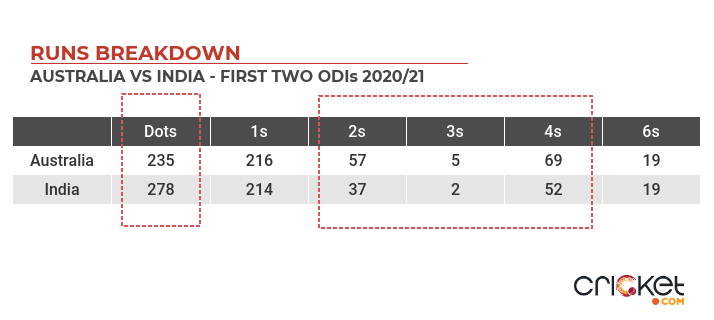 Due to the lack of strike rotation, there were overs which resulted in runs in single digits even when there was a six in them. Chasing a target in excess of 375 is an ardent task. But, the Indians made their task tougher by relying on boundaries alone. A few more shots in the gaps rather than an attempted hard hit to the fielder and India could have fought better.
Probable XIs
Australia: Aaron Finch (c), D’Arcy Short, Steve Smith, Marnus Labuschagne, Marcus Stoinis/ Cameron Green, Alex Carey (wk), Glenn Maxwell, Sean Abbot, Mitchell Starc, Josh Hazlewood, Adam Zampa
India: Shikhar Dhawan, Mayank Agarwal, Virat Kohli (c), Shreyas Iyer, KL Rahul (wk), Hardik Pandya, Ravindra Jadeja, Mohammed Shami, Shardul Thakur/T Natarajan, Yuzvendra Chahal, Jasprit Bumrah