

 MATCH REPORT
 Follow Us
It has been a while since India have batted so deep. Their numbers eight and nine in the first T20I against England had a 106-run partnership in the last Test. This was a reason which prompted Virat Kohli to say ahead of the series that now was the time for the batsmen to bat more freely and be more expressive.
The problem with sports is that the opposition will have plans of their own. And England did. It was to flummox India with a lack of pace to start with and unleash fiery fast-men as the game went ahead. Going into the T20 World Cup later in the year, the biggest area for improvement for England is their bowling. Tonight, they turned the game in their favour with the ball in the first six overs itself.
Adil Rashid has bowled only once in the Powerplay in T20Is since 2016. With Rohit Sharma rested, England would have identified KL Rahul as the most important player for India. They went with Rashid probably with the knowledge of Rahul's struggle against spin. He had a strike-rate of under 100 in an Orange Cap winning season in 2020. Rashid started with a frugal two-run over.
The ball was in the hands of Jofra Archer for the second over. India needed to get going. Forcing a drive with no feet movement, Rahul played on. Archer finished the wicket-maiden with discomforting Virat Kohli. The penultimate ball off a length to Virat Kohli and the last one made the Indian skipper attempt a slog. India were two for two after the first two overs.
Rashid continued from one end. Shikhar Dhawan put Kohli back on strike. He tried to make room, and made too much of it, to hit Rashid over mid-off but could not clear him. Kohli departed for a five-ball duck, his first consecutive ducks in international cricket.
Archer’s had an able company in Mark Wood. Bowling with a higher pace and harder lengths, Wood strangled India in Powerplay and middle-overs. Playing at a strike-rate of around 30 after 10 balls, Dhawan was under pressure. He became the third wicket to fall in the first six overs after he missed an ugly hoick to a ball that hit the bails. India ended the Powerplay at 22 for three, their second-lowest score in T20Is ever.
The only batsman who stood up to England in the Powerplay was Rishabh Pant who walked out to bat at four. Unlike the players above him, he started as a batsman among the runs. He did not miss out on a half-tracker from Rashid in the third over and cut it past point. The next over, the fourth of the innings, would have had James Anderson having a sly laugh back in his living room. To a 140kmph+ delivery by Archer, Pant unleashed a reverse ramp, as he did to Anderson in the fourth Test. Due to Archer's pace, the ball went all the way. He finished the over with a more trivial flick to the square leg fence.
After a dismal Powerplay, the pair from the Delhi Capitals resurrected India's innings for a while. Wood continued to breathe fire. Bowling at 150 mph, his back of length balls proved to be impossible to score off.
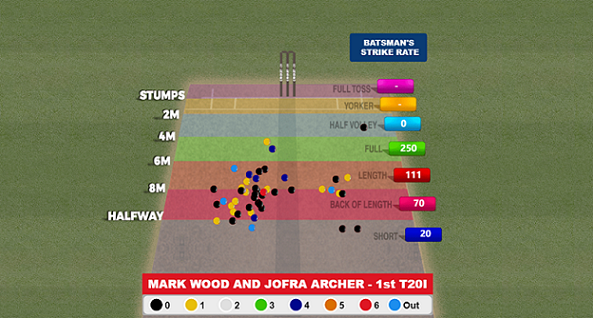
Sam Curran and Ben Stokes used variations to exploit the juice in the pitch. Just when India seemed to build a platform of sorts, they had a hiccup in the 10th over. Pant creamed a ball at his pads from Stokes but straight to the throat of deep square-leg. Thus, ended a 28-run partnership.
The only batsman who followed the age-old adage of getting his eye in before attacking was Shreyas Iyer. In the middle-overs, twice when offered a ball at his pads by the pacers, Shreyas Iyer glanced it to the fine-leg fence. When Stokes provided him room outside off, he hit him past third man. After an effective spell in the Powerplay, Rashid underwent a challenge. Aggressive against spin, Iyer used his feet and hands to hit a full ball between long-off and sweeper cover.
Iyer had Hardik Pandya for company next. Bowling the 15th over, Stokes missed his length once. Hardik had no second-thoughts before tonking it over the long-off fence. Stokes tried to bounce him in the next ball. Pandya produced another highlight-worthy moment of the day when he leaned to his left and played the ball off his bat face to the right of the keeper.
In IPL 2020, Archer had an economy of 4.6 bowling in the first 15 overs as compared to 9.8 in the last five. On a night when England bowlers did nothing wrong, he ended with just 12 runs in his last two overs. Eight of these came off the first two balls.
Archer started the 16th over with a ball on Iyer's pads. Nearing a half-century he had no issues on putting it away. The shot of the next ball was all class. He used Archer's pace to cream the ball past backward point. To a back of length ball in the next over, by Chris Jordon, Iyer made room to hit a flat six over the offside fence.
Archer bowled out in the 18th over but took two Indian batsmen with him. Hardik, caught at mid-off and Shardul Thakur, caught first ball at deep square-leg.
An exceptional grab by Dawid Malan at the deep-square leg ended Iyer's 67-run knock in the last over. Scoring 41 in the last five, India finished with an underwhelming 124. Iyer apart, none of the top seven batsmen scored at a strike-rate of over 100.
Unlike England, India did not have bowlers with raw pace. And the difference in impact was visible. The failure of India's openers can be pinned to their lack of recent game time. But, the same applied to England's openers. With a 72-run partnership for the first wicket, England made the subpar target of 125 seem mediocre.
The pace of Bhuvneshwar Kumar and Thakur was not enough to stop an assault by Jason Roy. Neither did Yuzvendra Chahal get enough turn or help from the fielders.
The only moment of brilliance came when England were 29 for no loss after four overs. Sedate till then, Jos Buttler danced down to hit Axar Patel over the ropes. The ball hung in the air for an eternity. Rahul, right at the boundary line, jumped in the air to push the ball back to the ground.
Rahul could do nothing to a crunch along the ground to the sweeper cover fence three balls later. Buttler got the six he was looking for on the next ball. A silky touch past mid-on earned him another four in the next over. He went past Roy in a hurry. In comparison to India’s 22 for three, England finished the Powerplay at 50/0.
Roy went ahead of his partner in a jiffy. With no baggage of red-ball cricket, he had no issues with dancing down to Axar and slog him over the leg-side fence. He subjected Chahal to the same treatment. He hit a half-tracker for a four to midwicket and the fuller one to follow up for a six over deep square leg. Chahal found Buttler in front for some relief but the end was imminent for India.
From a broader perspective, India had Hardik bowling. For Dawid Malan, the shortish lengths at his pace gave him two opportunities to swivel and run the ball to the fine leg fence.
Given two right-handers at the top, India did not start with their earmarked Powerplay specialist, Washington Sundar. Batting on 49, Roy wanted to play him to the onside for a single. He ended up missing the ball. It met his pads and he had to walk back.
Jonny Bairstow avenged the hurting from the Tests with two pleasing sixes off Chahal down the ground. India's premier spinner ended with a spell of 1/44. England chased the target down with 27 balls to spare. India lost out in all three departments.
In the end, Kohli admitted that they weren’t aware of what to do on the pitch and neither spent enough time assessing it. But, India still have four more games to try out the free approach with the bat, but mixing it with the needed respect upfront.