

 PRE MATCH ANALYSIS
 Follow Us
In the buildup to the series, England tried to label India as favourites for the T20 World Cup later this year. This was maybe to save themselves from being complacent. However, Virat Kohli was prudent enough to accept that England will be the team to beat. All the teams will be wary of their strength and what they bring to the park. England and India are at a different place in understanding their white-ball game. But, is the gap between the two sides is as glaring as we witnessed in the first T20I?
England are a batting behemoth in white-ball cricket. No other team match their uninterrupted barrage of firepower. Contrary to the popular belief of bowlers being the match-winners, England have based their team on consistent hitting through the course of an innings. It was on display with the ease with which they chased down a mediocre target of 125. Yes, India already had their minds on the next game soon after they came out to bowl. But, none of the Indian bowlers troubled the English batsmen at all. It was a sign of things to come.
Ahead of the series, Eoin Morgan said that they need to develop their game and go into a World Cup with as few weaknesses as possible. He was referring to their bowling unit. Before the first T20I, their economy rate was 8.83 since 2018. The worst among all sides.
There is a difference in the ongoing T20I series versus some others England have played in recent times. Much to Michael Vaughan’s dismay, Morgan has a full-strength squad to choose from. However, Morgan has not always “got what he wanted”. Before this series, England played 30 T20Is since 2018. Jofra Archer played seven of those, Ben Stokes played nine. Mark Wood played none. As Morgan admitted, he had the strongest squad available for this series which is not always the case. England did not win the first T20I with the bat. They won it by rattling India through the pacers.
Archer started off by dismissing KL Rahul and intimidating Kohli. He came back at the end to better his death over numbers and devoid India of a big finish. He bowled only two balls in the full region in the game. Wood started with a full ball but did not bowl anywhere near that length again in the match. His spell included balls around and above 150kmph, delivered at nasty hard lengths making the batsmen focus on survival more than scoring. The pair took 4 for 43 in their eight-over spell. They were the weapon Morgan did not possess often enough.
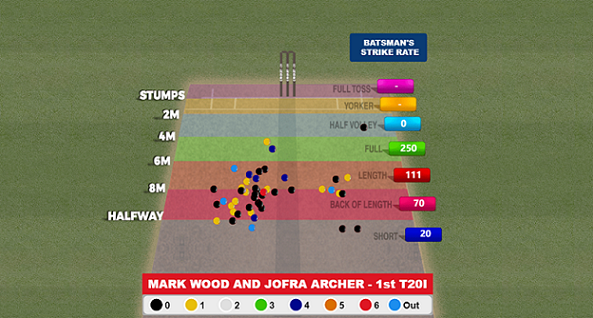
The duo provided a template for the others to follow. Chris Jordan did not attempt his go-to ball: the yorker. Sam Curran and Stokes played around with variations of the slower ball but did not experiment against the proven lengths. England’s weakness was their strength in the first T20I.
What caught India off guard was how it began. Adil Rashid had bowled only once in Powerplay since 2016. Playing as a lone-spinner, India would not have expected him to bowl with the new ball. He slipped in a quiet first over. As Kohli indicated before the game, given the depth in the batting line-up, India’s batsmen planned to bat more freely. They had to get on with it quickly and thus had to target the wrong bowlers and tougher lengths. India were three down in no time. The depth in the batting was not adept enough to bring the team out of a start like that. That too on a day when England bowlers had everything going for them.
Shreyas Iyer said after the match that the new philosophy of carefree bating would not change. And it is a fair thought. It will be foolhardy to jettison the approach needed in this era after one failed outing. The fundamental issue with the Indian side is not the approach but the set-up of their batting unit. In the absence of Rohit Sharma, KL Rahul and Hardik Pandya were the only two players in the top-six with a T20I strike-rate of above 140 since 2018. Whereas in England, only Ben Stokes has a sub 140 strike-rate in the top six. Three of the other five have a strike-rate of above 150.
More importantly, there is a difference between how the top-order from both sides start their innings. And even then, not every player in England’s side go all-out from the first ball itself.
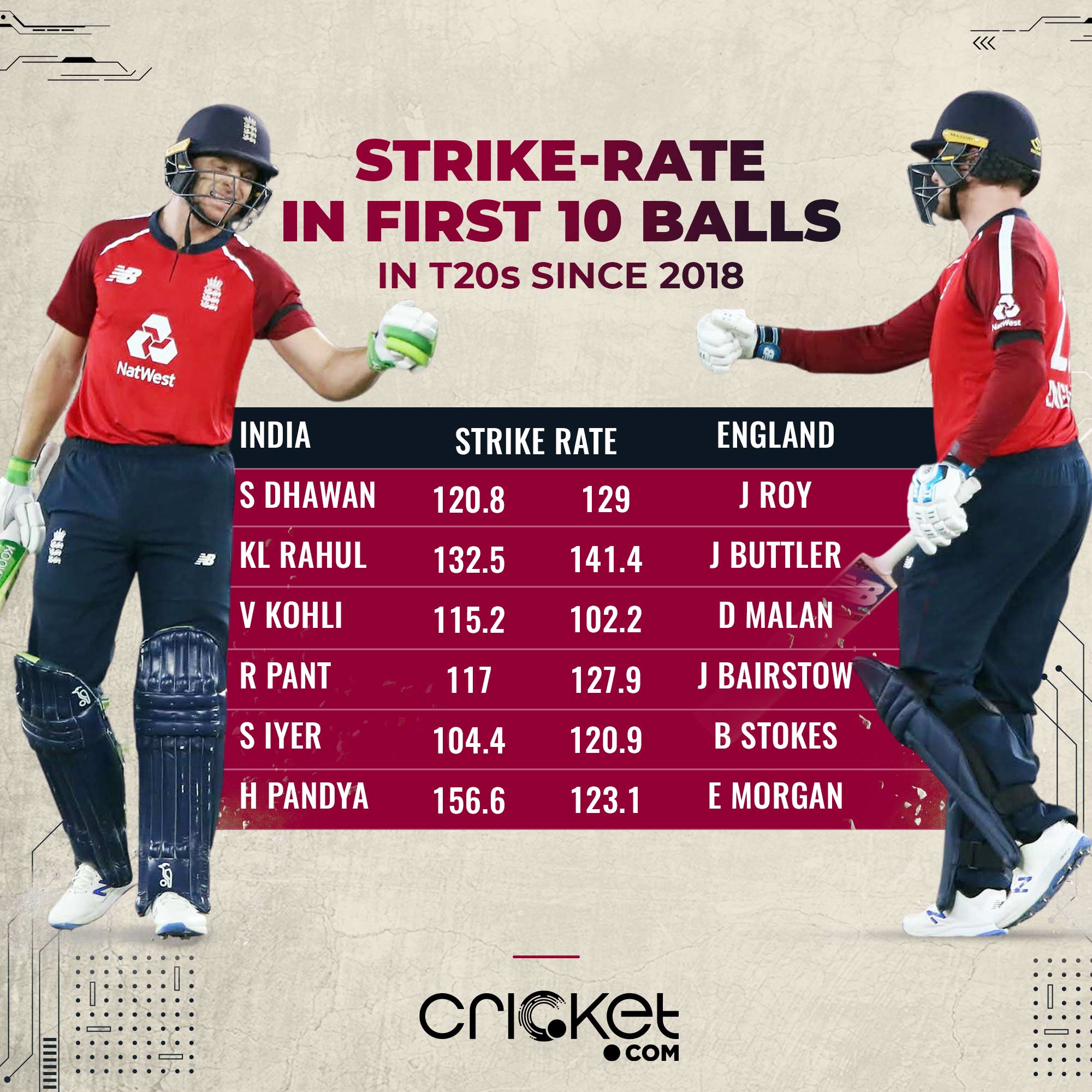
With a deep batting line-up – how much ever unproven the lower-order maybe – India need to take the courageous call of including more natural hitters in the top five. It will be unwise to ask players that have built their T20 game in a certain way to adopt a different method, months before the World Cup. If India can find a way to coalesce the two approaches, the gap between the two sides might reduce by the time the series ends.