

 OPINION
 Follow Us
“We have played with a certain kind of pattern in the past. We did not have a big tournament to work towards. If you look at the squad, the additions we have made, we have tried to address a few things we needed in specific. Guys who can be 'x factors' with the bat and do things which are the need of the hour in T20 cricket”. Virat Kohli’s statement on the eve of the series opener about the addition of fresh faces like Suryakumar Yadav and Ishan Kishan signalled two things. One was a realization that India were playing an outdated brand of T20 cricket. And the second was an acceptance of a need to change that ahead of the World Cup.
India won the World T20 in 2007 with fresh faces thrown in with the more attacking ODI cricketers. For years after that, India’s method to T20 cricket was to see it as a shortened ODI. With time, India fell behind teams like West Indies who encouraged more boundary hitters. Till 2016, when the last T20 World Cup took place, India were not as big a bowling powerhouse as they are now anyway.
It is not unusual for Kohli to make assertive statements in the heat of the moment. In the first T20I against England, India fielded an XI with only two batsmen in the top six with a career T20I strike-rate of more than 140. None of the ‘x-factors’ made it to the XI. The batsmen, who have spent their careers batting as an anchor for their respective IPL franchises, seemed in a hurry to adopt the modern-day T20 approach. India were three down in the Powerplay and ended the game with just 124 on the board. England won the game with ease.
By the time of the fifth T20I, India not only overcame the debacle of the first game but realized the art of scoring enough runs to bury England under the scoreboard pressure. What changed? The answer lies in embracing the ‘x-factors’ in the nick of time.
The middle-overs lift
As we pointed out before the first T20I, India’s approach in the middle-overs needed a lift. Their run-rate of 8.01 in the overs 7 to 15 in T20Is since 2018 was lower than all four SENA countries. Batting first, India lost three wickets inside the Powerplay in the first T20I. With a start like that, a cautious approach led them to score 61 in the nine overs to follow then.
India swapped Shikhar Dhawan with the more aggressive Ishan Kishan as an opener in the second T20I. The effect was immediate. A natural boundary hitter, Kishan carried on even after the Powerplay to score a fifty on debut. Statistically, the seventh over of a T20 innings is the one with the lowest run-rate: 6.7 in T20Is featuring full member nations of the ICC. Kishan and Kohli smashed Ben Stokes for 17 runs in that over, the most in the innings. India went on to add 93 runs in the nine overs in an easy run-chase.
In the third T20I, India batted first and lost three wickets in the Powerplay again. The middle-overs were the replica of the first T20I. A niggle to Kishan resulted in Surya’s inclusion in the XI in the next game. India opted to take a pragmatic call of batting him at three, a position he has made his own for the Mumbai Indians. He hit the first ball he faced for six and did not look back after that. Despite losing Kohli early, India scored a decent 83 in the nine middle-overs.
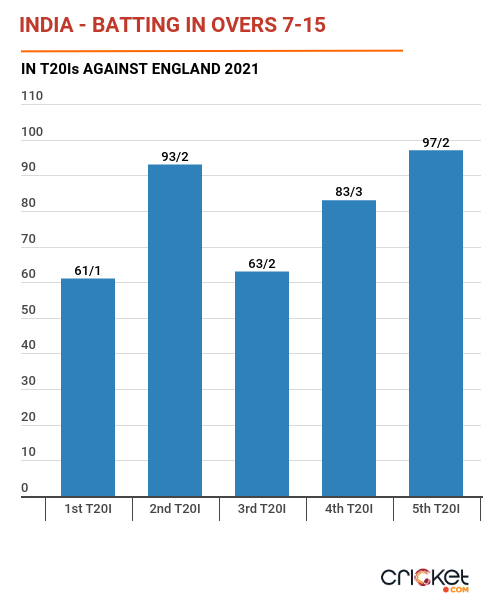
In the decider, India rejigged the line-up again but shifted it on the side of being more aggressive. Kohli went at the top with Rohit. There were no early jitters as the pair batted well past the Powerplay. In T20Is since 2018, Kohli, Shreyas Iyer and Hardik Pandya – the crux of India’s middle-order - have a strike-rate of under a 100 against spin in the first 10 balls. Surya hit Adil Rashid for two gorgeous sixes on the second and third ball he faced against him in the fifth T20I. He hit him for ten runs on the same two balls in the previous T20I as well. India scored 97 runs in the nine overs on the way to their fourth-highest T20I total in the decider.
About the opening combination, in a characteristic spontaneous reaction, Kohli has thrown his name to open with Rohit in the World Cup. This comes after claiming Rohit and Rahul to be the first-choice opening combination on the eve of the first T20I. A lot can change between now and the World Cup but going by what Kohli achieved in IPL 2016, that seems like the best place for the best anchor cricket has ever seen.
Bucking the trend and a question unanswered
The side winning the toss and opting to field won the first three games of this series. This is a growing trend that should alarm the saviours of T20 cricket. No team has surrendered to this trend more than India.
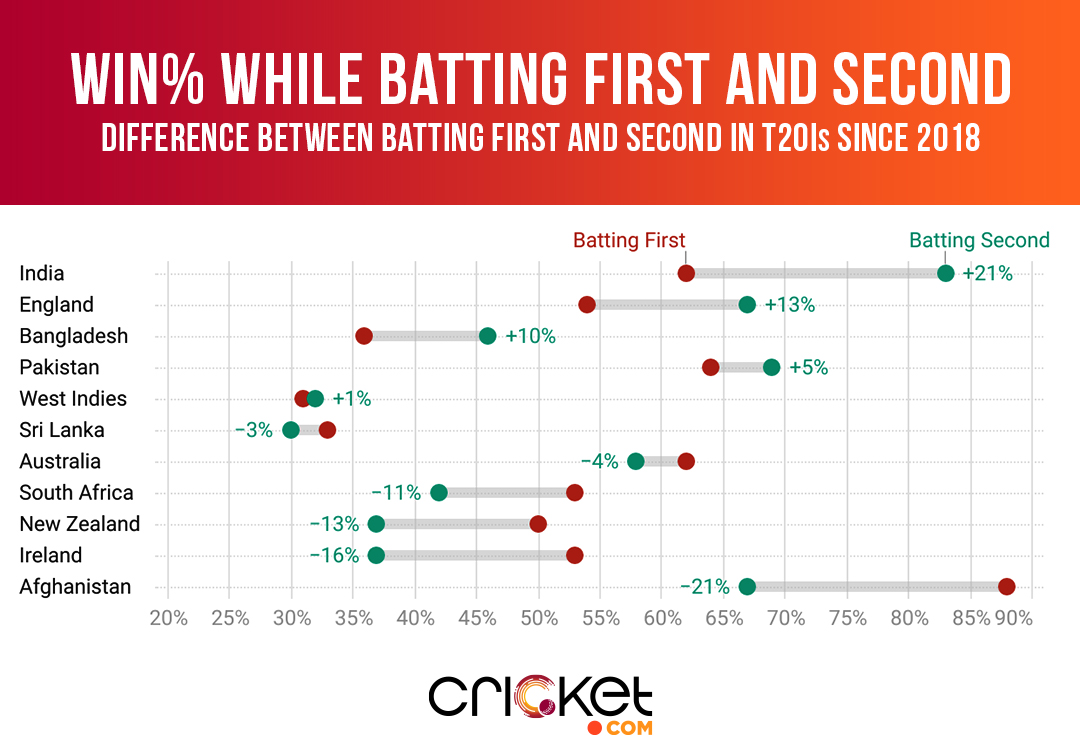
In T20Is since 2018, the difference in win percentage while batting second versus first for India is 21% - the highest among all sides. Learning to set-up challenging totals with the help of aggressive batters, India managed to win the last two games after England asked them to bat. Looking ahead, this was a bigger plus for India than the outcome of the series.
On the bowling front, it is fair to say that the pacers got the better of England’s bullish batting line-up. Even without their spearhead, Jasprit Bumrah. Bhuvneshwar Kumar was fit and back at his frugal self. He ended up with a series economy rate of 6.4. Hardik being able to bowl was another big story. He did not just bowl but was the difference between the two sides in the fourth T20I. Shardul Thakur used his variations to chip in with timely wickets.
A question left unanswered after the series is the choice for India’s frontline spinner. Yuzvendra Chahal has been lacklustre since 2019 and thus made way for Rahul Chahar after the third game. Rahul impressed in his first outing of the series but did not have an impact in the last game. Washington Sundar too was patchy with the ball. A fit Ravindra Jadeja would walk into the XI. But, that will still leave room for India to nail down their premier spinner. Maybe the IPL this year throws in an ‘x-factor’ on the spinner front too.